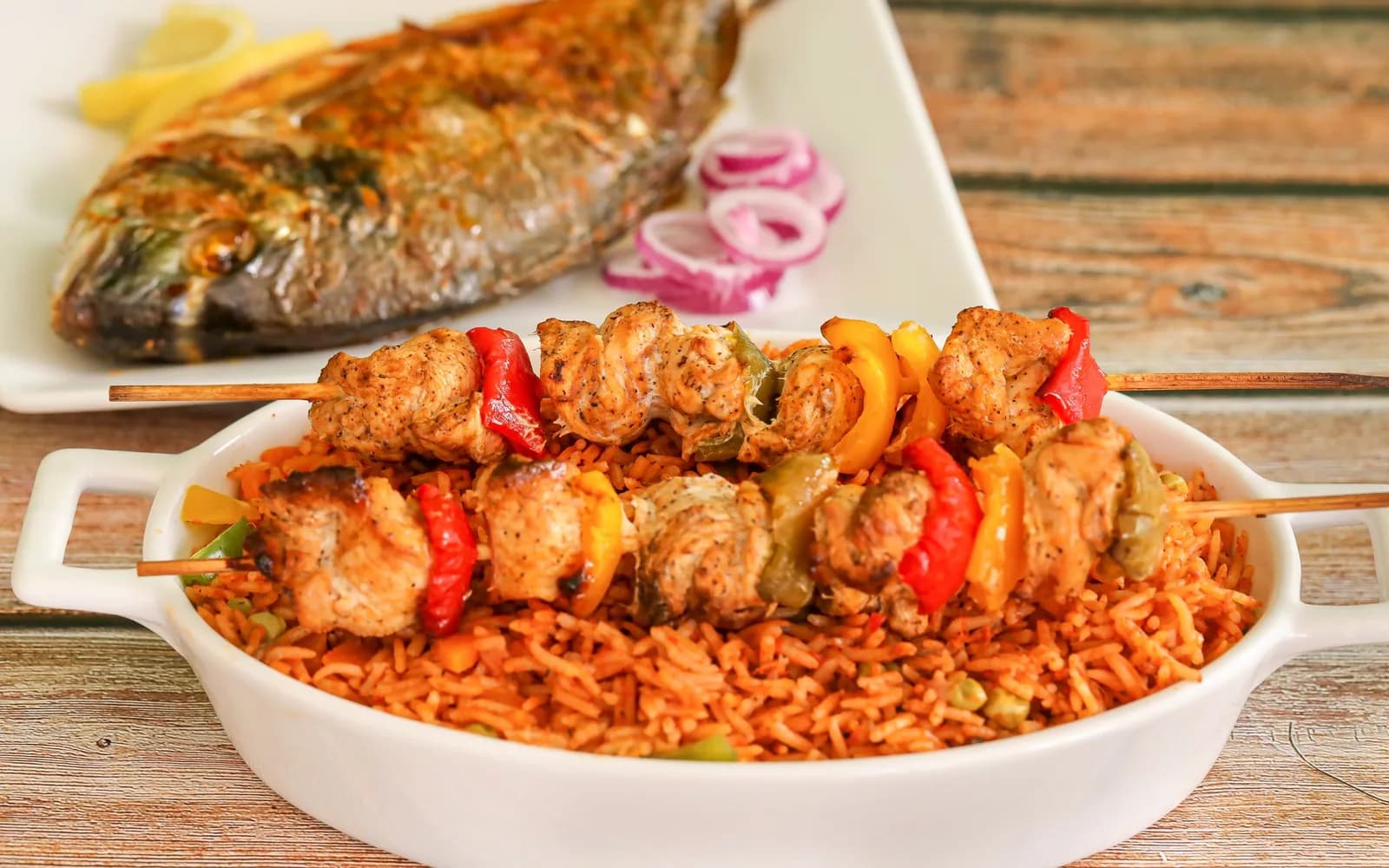
Party Jollof Rice
Nigerian party jollof is its own category: cooked in enormous pots over open fire, stirred by someone who has done it a thousand times and still watches the oil rise before trusting the rice. This is a Nigerian preparation for home kitchens — not a claim that any one country's jollof is 'best,' but a faithful base for the version your family already makes.
- Time
- 1 hr 45 min
- Serves
- 8–10
- Patience
- Some patience
- Occasion
- Party & celebration
Where this dish comes from
Jollof rice is shared across West Africa, and every nation and every household has a settled opinion on pepper, smoke, and rice type. In Nigeria, party jollof — cooked for weddings, birthdays, and any gathering that needs to feed a crowd — is distinguished by deep red color, parboiled rice that holds its grain, and that coveted smoky bottom layer some families prize and others avoid.
This template follows the Nigerian party-style sequence: reduce a pepper base, fry tomato paste until it darkens, coat the rice in stew, then steam low and slow. Use it while you interview whoever holds the jollof authority in your family.
Ingredients
Pepper base
- 6 ripe plum tomatoes (about 1 1/2 lb / 680 g), roughly chopped
- 2 red bell peppers (tatashe), seeded and roughly chopped
- 1–2 scotch bonnet peppers, stemmed (adjust to family heat)
- 1 large onion (about 8 oz / 225 g), half for blend, half thinly sliced
- 3 tbsp (45 g) tomato paste
The pot
- 3 cups (600 g) long-grain parboiled rice (e.g., Golden Sella or Uncle Ben's parboiled), rinsed until water runs clear
- 1/3 cup (80 ml) neutral oil or light palm oil
- 2 tsp curry powder
- 1 tsp dried thyme
- 2–3 bay leaves
- 2 seasoning cubes (about 8 g each), crushed
- 2 1/2 cups (600 ml) chicken stock, plus more as needed
- 1 tsp salt, plus more to finish
Optional party additions
- 1 lb (450 g) chicken thighs or drumsticks, seasoned and grilled or fried, to serve alongside
- 2 ripe plantains, sliced and fried, for serving
The method
Step 1: Blend tomatoes, bell peppers, scotch bonnet, and half the onion with 1/4 cup (60 ml) water until completely smooth. Pour into a wide pot and simmer uncovered over medium heat, stirring occasionally, until the raw smell disappears and the volume reduces by half — about 15–20 minutes. The color should deepen from bright orange to brick red.
Step 2: In your heaviest pot, heat the oil over medium. Add the sliced onion and fry until soft and translucent, 4–5 minutes. Stir in the tomato paste and fry, stirring constantly, until it darkens one shade and smells toasted — about 3–4 minutes. This step is where the jollof gets its color.
Step 3: Pour in the reduced pepper base. Add curry powder, thyme, bay leaves, and crushed seasoning cubes. Cook, stirring often, until the stew thickens and you can see a thin layer of oil rising to the surface — 12–18 minutes. Do not rush; elders watch for the oil, not the clock.
Step 4: Stir in the rinsed rice until every grain is coated red. Add the stock and salt. The liquid should sit just below the level of the rice — jollof steams more than it boils.
Step 5: Cover tightly with foil or parchment under the lid to trap steam. Cook on the lowest heat for 25–30 minutes without lifting the lid or stirring.
Step 6: When the rice is nearly tender, raise the heat to medium-high for 2–3 minutes if your family prizes the smoky bottom layer (the 'party smoke'). Some households consider burnt rice a scandal — ask before you char.
Step 7: Rest off heat, lid on, for 10 minutes. Fluff from the sides inward with a fork. Taste and adjust salt. Serve with fried plantain and protein on the side.
Family notes ✎
- Yoruba households often lean on more tatashe for sweetness; Igbo and Delta versions may run hotter on scotch bonnet. Neither is wrong — document yours.
- Many families drop the scotch bonnet in whole and remove it before serving rather than blending it in.
- Party jollof cooked over firewood gets smoke no home stove fully replicates. A brief high-heat finish is the diaspora approximation.
Substitutions
- Preferred: Long-grain parboiled rice — it holds shape and absorbs stew without turning mushy.
- Preferred: Red palm oil mixed half-and-half with neutral oil for deeper color and aroma.
- Emergency: Basmati or Golden Sella basmati if parboiled rice is unavailable — rinse well and reduce initial liquid by 1/4 cup (60 ml).
- Emergency: 1 tbsp (15 g) paprika added with the tomato paste if bell peppers are pale or out of season.
On the calendarOwambe parties, weddings, birthdays, and any Sunday that needs to feel like a hall full of aunties.
Dietspora · Recipe Ebook
The Nigerian-American Table
Nigerian-American
Go deeper
The Nigerian-American Table
Nigerian home cooking for the diaspora kitchen — 51 recipes and pages to record your family's version.
Get the guide — $29